
11alive

PODCAST EPISODE #8: Jeff Reid, producer, “Black in America” & “50 Years of Change”

Can local TV stations produce compelling documentaries?

Allow me to make the argument against that idea:

  • Documentaries require significant topics.
  • Documentaries require significant resources.
  • Documentaries require significant talent.
  • Documentaries require significant vision.

Now, I would never argue that local news stations lack the vision, talent, resources, and topics to do compelling work. But very few have enough of each to commit to producing a hour of worthy television — that is, an hour beyond the numerous hours of newscasts they already produce.

And yet, last week, my station premiered a documentary, “50 Years Of Change”, about the Civil Rights events of 1963; it received praise from both viewers and local leaders. It is a product on which I had the privilege to work, and of which I am very proud. It aired on our station, WXIA-TV in Atlanta, last Wednesday, and an abridged version has been made available for schools to show their social studies classes.
(more…)

PODCAST PREVIEW: Jeff Reid: “This is one of my finest hours”

A week ago, I spoke of my pride for taking part in “50 Years Of Change”, an hour-long documentary about the Civil Rights events of 1963. It premiered last week to great acclaim from viewers and local leaders.

Now, allow me to introduce you to the man behind it.

Jeff Reid has been a co-worker of mine at WXIA-TV in Atlanta for more than a year; he joined us after spending 15 years at CNN, spearheading their documentary department and producing the much-discussed “Black in America”. He manages our enterprise content, meaning he oversees the production of long-form stories and investigations.

His other big mission? Get a few documentaries under our belts — and make them great.

In the recent history at our station, we had done the occasional single-topic newscast and even a documentary or two, but we had not tackled a topic as heavy as the Civil Rights movement — and we certainly had not filled an hour doing so — until “50 years Of Change”. For his part, Reid had never produced a documentary with so little time and staff; he spearheaded this one with a team of 8-10 people in barely a month.

Reid discusses the process with me on this episode of the Telling The Story podcast.

(more…)

JFK, MLK, and the crafting of a Civil Rights documentary

Rarely, as a local TV news reporter, do I get to spend two weeks on one story.

Rarely does that story get to be eight minutes long.

And rarely do those eight minutes contain an arsenal of powerful interviews from iconic figures.

So, when I received the opportunity to work on such a story earlier this month, I knew it would be special.

This week marks the 50th anniversary of the March on Washington and the “I Have a Dream” speech from Dr. Martin Luther King, Jr. With that anniversary comes a documentary from my station in Atlanta, WXIA-TV, called “50 Years of Change”, which looks back on not just the famous march but the other major civil rights events of 1963:

  • the declaration, “Segregation now, segregation tomorrow, segregation forever!” from Alabama governor George Wallace
  • the child protests in Birmingham
  • the nationally televised speech on civil rights from President Kennedy
  • the murder of Medgar Evers a day later
  • the 16th Street Baptist Church bombing in Birmingham
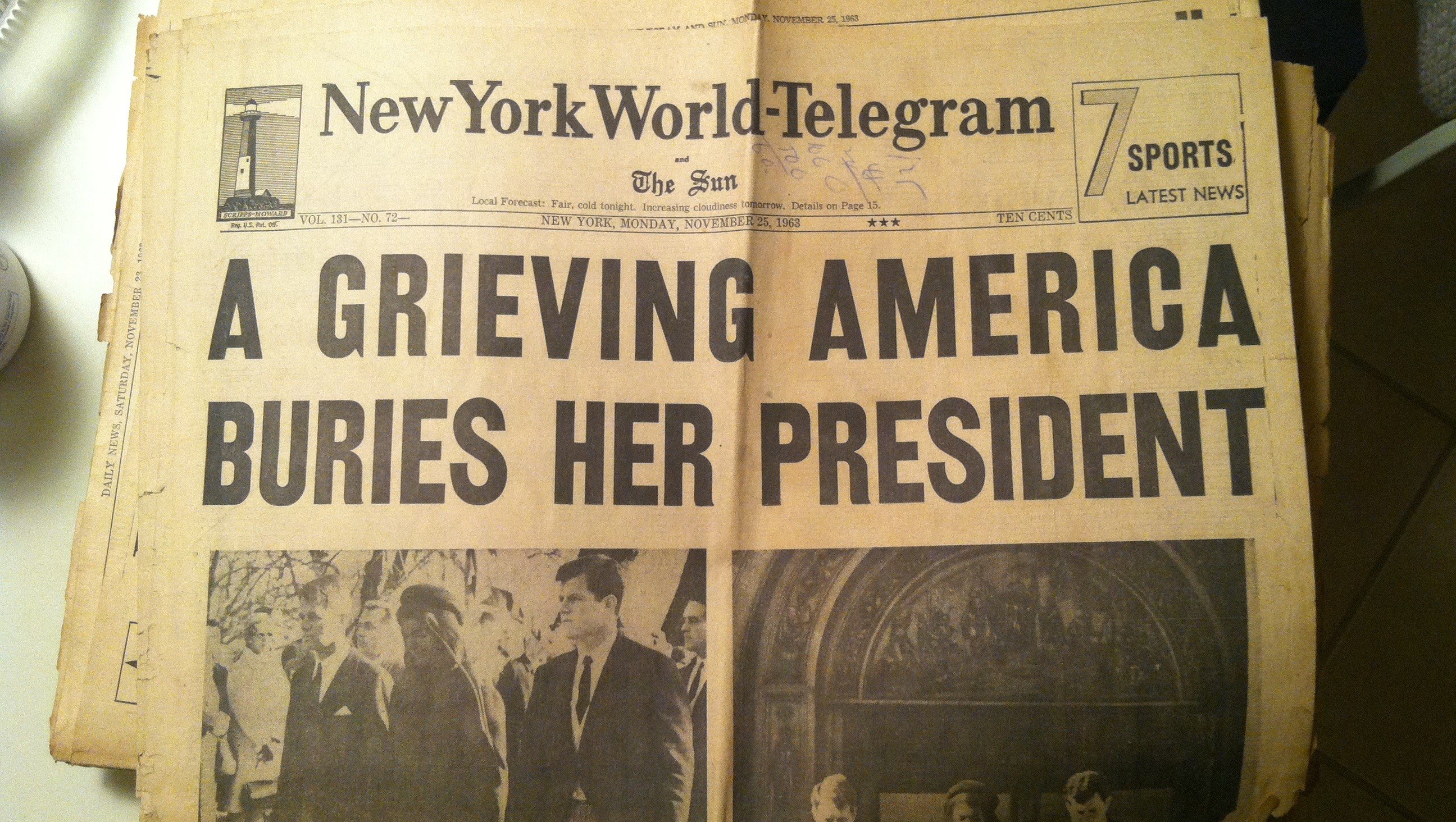
  • the assassination of President Kennedy

It’s an impressive list. (Last week we screened the documentary for local Atlanta leaders, and roughly three-quarters of the way through, one of the attendees turned around in his chair and remarked, “Man, a lot happened in ’63!”)

I was assigned the final story on the above list: the killing of John F. Kennedy, and what that meant for the civil rights movement. I went down to Dallas for a few days to get footage of the famous spots from the assassination (the book depository building, Dealey Plaza). I also interviewed several people who had been in Dallas that day, one of whom was a radio reporter at the time and stood a half-block away from Kennedy when the assassination occurred. Following that trip, I spent several days simply cobbling together old footage and photos — a difficult task, since most of the footage I wanted came with a price tag that exceeded our budget. Finally, I required two days to edit the whole thing, which included several hours reformatting all the old footage so that it looked consistent.

The process was exhaustive — and absorbing. But of all those arduous tasks, the most important thing I did was seemingly the simplest:

Listening.

(more…)

Beep baseball, and my two minutes of blindness

It had been a frustrating morning.

Back in May I was made aware of a baseball team in my home city of Atlanta that played every Saturday during the spring. The team was special for a powerful reason: each of its players was deeply visually impaired, if not completely blind.

At the time I anticipated a tremendously moving story, but I could not find a day to shoot it before their season ended. However, I was told, the team — named the Atlanta Eclipse — would be a part of a truly special event in late July: the World Series of beep baseball.

(The sport is called “beep baseball” because the ball beeps, so that the players can hear it.)

I then learned that the World Series would feature 19 teams from around the country, as well as the defending world champions from Taiwan. Beyond that, it would be held in Columbus, Ga., a mere 90-minute drive from Atlanta.

I got excited. The story, I felt, had great potential; I would simply have to cool my heels for two months until the Series arrived.

But now, nearly two months later, I was frustrated.

I had arranged to shoot a practice several weeks before the Series, but the day beforehand I learned that a majority of the players would be unable to attend, for various reasons. I showed up on a rainy Saturday morning to find just three players — along with their aides and the team’s volunteers and coaches.

Because of that, and because of the weather, I did not have much to shoot. I got whatever video I could, but I knew it would pale in comparison to what I would see at the World Series.

Hence the frustration. No one was to blame, but I found myself spending valuable weekend hours on a shoot that had produced disappointingly little.

So I decided to play.

(more…)

“Telling The Story” podcast guests on: changes in journalism

I am on vacation — and out of commission — for the next two weeks, so I figured I would use my usual Wednesday space to put together some of the stronger exchanges and sound bites from the first six episodes of the “Telling The Story” podcast.

Next week, I will post the highlights on the topic of advice for young journalists and storytellers. This week, here are three segments on the changing landscape of journalism, which is a frequent topic here on the blog:

“We can be those outsiders, telling a story that’s important”: Jon Shirek was my first guest on the “Telling The Story” podcast, and he remains a storyteller and co-worker who I greatly admire. In this segment, Shirek talks about how storytelling has changed in the past three decades — and how, in his words, we are still “outsiders on behalf of outsiders.”

CLICK HERE for the full podcast.

“[The iPhone] does have a role in what we do”: In the aftermath of the Chicago Sun-Times’ decision to fire its photography staff, I called up veteran Indianapolis Star photojournalist Matt Detrich for an honest and insightful discussion of the future of newspaper photography. Detrich spoke mostly of his disappointment in the Sun-Times’ decision, but in this exchange, he did offer some positive words about the potential for the iPhone camera.

CLICK HERE for the full podcast.

(more…)

15 seconds or less: Meditations and ruminations on online video

Here are, for your consideration, some anecdotes and observations from the past few weeks:

*****

While out on a story several weeks ago, I met a reporter for a local Patch.com site; Patch is a web-based news operation brought to you by the folks at AOL. This reporter had her cell phone out, prepared to use it as a video camera.

We talked briefly about online video, and she made the following statement:

“My editors tell me my video can’t be any longer than 15 seconds. Anything longer than that, and people won’t watch.”

*****

While out on a different story, I met a newspaper reporter who is investing his time in a video piece to put online. He has spent many days, often on weekends, investing in a mini-documentary that currently stands at ten minutes. He said he will likely finish the piece in the next few months.

The only problem? He cannot find anyone who wants to use it — or, more specifically, any media outlet that knows what to do with it.

*****

A non-industry friend and I were recently discussing my job, and she asked if I treated my stories differently depending on which show would use it. In other words, would I tell a story for the 11 pm news differently than I would tell that same story for our morning show?

I said, while I did make certain concessions and alterations for the show-specific audiences, I ultimately had to assume that the story would see its greatest interaction online. For the most part, web readers and viewers do not care about the show in which the story ran; they watch the story independently of that.

(more…)

The Emily Bowman story, and finding honesty amidst heartbreak

It was pitched to me as a heart-warming story.

When I walked in the door last Thursday at WXIA-TV, I learned my producers had already lined up my assignment. I would head out to Woodstock, Ga. — roughly 40 minutes northwest of Atlanta — and cover the homecoming of 19-year-old Emily Bowman, who had spent the last four months in the hospital.

Bowman, a student at nearby Kennesaw State University, spent three weeks in a coma after being hit by a drunk driver back in February. She made small improvements in the following months, while police arrested the young man who they believe crashed into her.

Now, she was coming home — and we would be there to document it.

In the morning meeting, producers described the story with words like “great”, “beautiful”, and “uplifting”. On the surface, these words seemed to be accurate; Emily’s friends and family had been eagerly awaiting her return, and a local charity had even remodeled her home to make it wheelchair-accessible. We pictured all the wonderful potential moments that would touch our viewers’ hearts.

And then, one of my fellow reporters raised her hand and interjected.

“You guys know she can’t walk or talk, right?”

(more…)

Going gold for Silas, and the value of repetition

I was responsible for this past week’s most popular story on my station’s web site, 11alive.com.

In the piece, I profiled a 4-year-old boy from east Georgia who is battling a rare cancer that cannot be cured; he has been told he may only live for a few more days.

The story has been viewed more than 10,000 times; several of my co-workers told me the following day how much it moved them.

And the most moving moment? Initially I did not know if I liked it.

Let me offer a little background. The previous Friday, I drove down to the 4,000-person town of Lyons, Ga. to meet the young boy, Silas, and his family. In his final days, Silas had started a movement for everyone to paint their nails gold to raise awareness of childhood cancer. The movement had reached 30,000 likes on Facebook, with photos of gold-painted nails pouring into the family’s inbox.

Silas’ family members welcomed me into their home for a brief time. During that time, Silas did not say too much, but he did at one point take part in a moving, heart-breaking exchange with his mother.

“I don’t know what the bad news is,” Silas said about his situation. When his mom asked, “OK, well what’s the good news?” Silas responded by saying this:

“The good news is … is … soon I’m going to heaven.”

I thought about that moment the whole way back to Atlanta. I knew it would be the centerpiece of my story, and indeed I wrote it as such the following week.

When I showed the piece to my news director, she loved it but had one major point of advice:

“You need to play that line again,” she said about Silas’ “going to heaven” line.

Play it twice?

(more…)

PODCAST EPISODE #1: Jon Shirek, reporter, WXIA-TV

Let the next chapter begin.

Two months after kicking off the Telling the Story blog, I am proud to introduce the Telling the Story podcast. This will continue the discussion about how journalists — and all of us — reach the world. Each episode of the podcast will feature an esteemed storyteller, answering questions and conversing about both the craft of storytelling and its role in the changing media landscape.

I could not be more thrilled to begin the podcast with one of my favorite storytellers: WXIA-TV reporter Jon Shirek.

Jon is a friend and colleague of mine. We have worked together for four years at the NBC affiliate in Atlanta; of course, I arrived just as Jon was beginning his fourth decade at the station. He is, I would say, the most respected and veteran storyteller in a newsroom that houses many great ones.

He also recently made a big change. Five years ago Jon was asked to become a backpack journalist, meaning he would have to shoot and edit his own stories instead of working with a photographer. He warily accepted the challenge, and he continues to crank out terrific work.

This is no small feat. Young journalists today are told in college they will have no choice but to shoot their own stories. Jon had been working with a photographer for several decades before he was asked. To learn the skills while remaining a great storyteller has been an impressive achievement, one that often gets taken for granted in the WXIA newsroom.

“I think it has made me a better reporter in a lot of ways,” Jon told me. “It has helped me economize my approach to stories so that I have a better idea, while I’m talking to somebody, the direction the story needs to go.” That said, he notes, “I am still a work in progress. I cannot pretend to be a photographer after five years.”

(more…)

PODCAST PREVIEW: Jon Shirek on how “good storytelling will always be good storytelling”

Tomorrow, we begin a new chapter at the Telling the Story blog.

The Telling the Story podcast.

I am excited to bring the discussion to audio form, starting with a great first guest. Jon Shirek, a reporter and my colleague at WXIA-TV in Atlanta, joins me for a 30-minute discussion about backpack journalism, the changes in local news over three decades, the crafting of storytelling, and the challenges of leaving a journalistic legacy.

His one sentence that sums it all up? “Good storytelling will always be good storytelling.”

(more…)